
Reducing Food Waste with Real-Time Inventory: How Technology Is Helping Restaurants Operate Smarter
Food waste is one of the biggest challenges facing the restaurant industry today. Every ingredient that expires, every product that is over-ordered, and every item that goes unused represents more than just wasted food — it represents lost revenue, reduced profitability, and operational inefficiency.
For restaurants operating on tight margins, controlling food costs is critical. A small amount of waste across hundreds of ingredients and thousands of transactions can quickly add up to significant financial losses.
The challenge is that many restaurants do not have the visibility they need to understand where waste is happening or why it is occurring.
Without accurate, real-time inventory information, operators are often left relying on assumptions, manual counts, and outdated reports to make important purchasing decisions. By the time a problem is discovered, the opportunity to prevent it has already passed.
The future of reducing food waste starts with a simple shift: moving from periodic inventory checks to continuous inventory intelligence.
The Hidden Cost of Food Waste
Food waste in restaurants happens in many different ways.
Sometimes it is obvious — such as spoiled ingredients being thrown away after sitting unused for too long. Other times, waste is hidden within everyday operations:
- Ordering too much inventory based on inaccurate forecasts
- Overstocking ingredients that do not move quickly enough
- Failing to identify products approaching expiration
- Losing track of inventory stored in different locations
- Preparing more food than customer demand requires
- Inefficient stock rotation practices
Each individual issue may seem small, but together they can have a major impact on profitability.
Many restaurant operators know that waste exists, but the larger challenge is identifying exactly where it is occurring.
Is a specific ingredient being over-purchased?
Are certain products consistently unused?
Are storage areas being managed effectively?
Are purchasing decisions aligned with actual consumption patterns?
Without accurate data, these questions are difficult to answer.
Why Traditional Inventory Methods Fall Short
Most restaurants still rely on traditional inventory management processes.
Employees manually count products, record quantities, compare inventory levels against sales, and make ordering decisions based on previous experience.
While these methods have been used for years, they create several challenges.
First, manual counts only provide a snapshot of inventory at a specific moment in time. They do not show how inventory moves throughout the day or why discrepancies occur.
Second, manual processes are vulnerable to human error. Items may be missed, quantities may be entered incorrectly, and inventory records may quickly become outdated.
Finally, traditional methods are reactive instead of proactive.
Restaurants often discover waste after it has already happened — after ingredients have expired, after products have been overstocked, or after money has already been lost.
To truly reduce waste, restaurants need to understand inventory movement before problems occur.
The Shift to Real-Time Inventory Intelligence
The solution is moving beyond periodic inventory checks and toward continuous visibility.
Real-time inventory intelligence gives restaurants an ongoing understanding of what products they have, where those products are located, and how they are being used throughout the operation.
This creates a much more accurate picture of inventory activity.
Instead of asking, "What did our inventory look like during our last count?" restaurant operators can ask:
- What inventory do we have right now?
- Which ingredients are moving fastest?
- Which products have been sitting too long?
- Where are we seeing unexpected losses?
- Are our purchasing decisions matching actual demand?
These insights allow restaurants to make faster, smarter decisions that directly impact profitability.
How RFID Helps Reduce Food Waste
Radio Frequency Identification, or RFID, is one technology helping restaurants achieve this level of visibility.
RFID uses wireless communication between tags and readers to automatically identify and track products as they move throughout an operation.
Unlike traditional barcode systems that require employees to manually scan each item individually, RFID can automatically capture inventory movement without interrupting normal workflows.
This creates a continuous digital record of inventory activity.
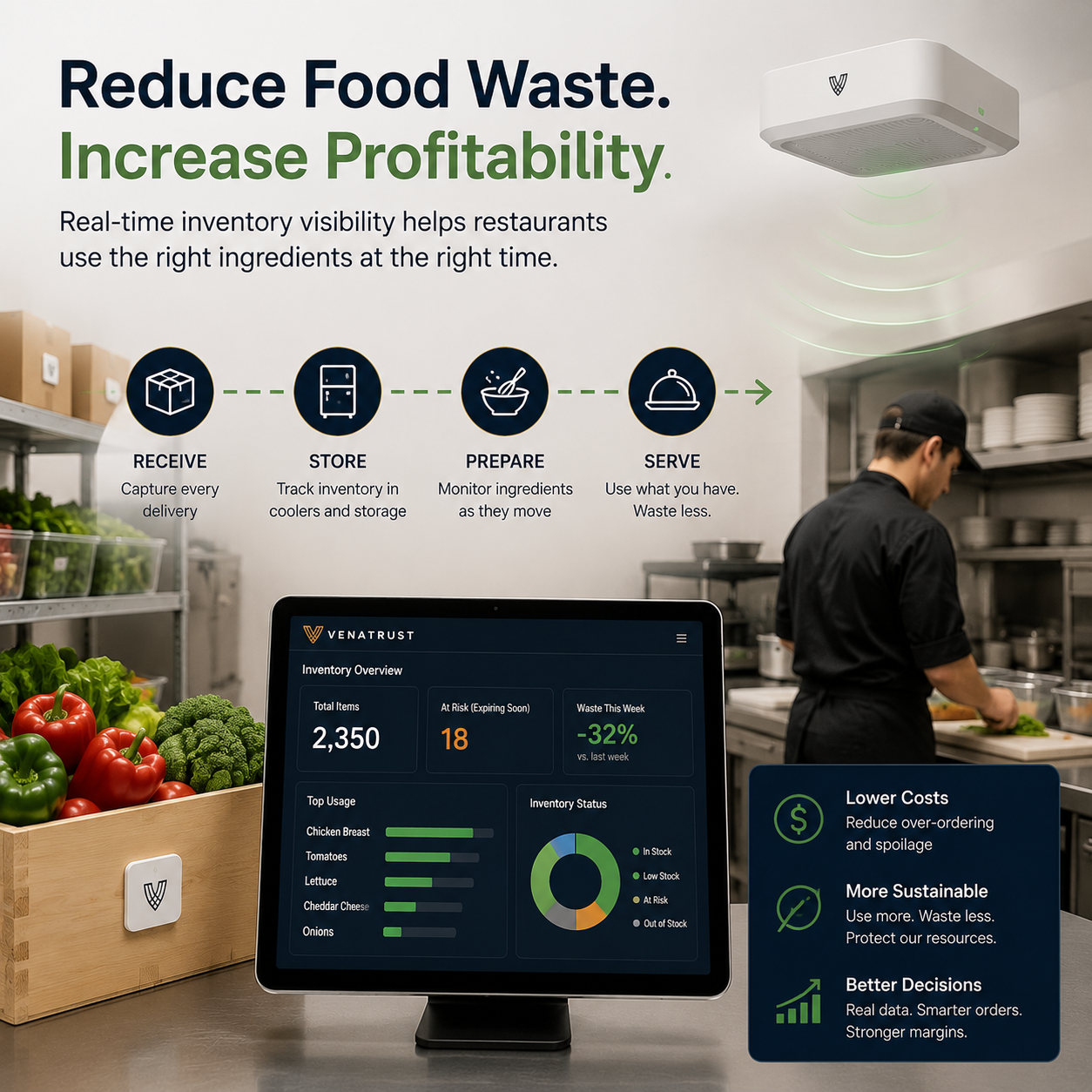
With RFID-enabled inventory tracking, restaurants can better understand the journey of their products — from receiving, to storage, to preparation areas.
Venatrust's Multizone RFID Technology
Venatrust helps restaurants create continuous inventory visibility through RFID-powered multizone technology.
By strategically placing multizone RFID readers throughout a restaurant environment, operators can monitor inventory movement across critical areas of the operation.
This can include:
- Receiving areas where products enter the restaurant
- Storage locations such as coolers, freezers, and dry storage
- Preparation areas where ingredients are used
- Operational zones where inventory movement impacts daily workflows
As inventory moves between these areas, Venatrust captures that activity and transforms it into actionable intelligence.
Instead of relying only on manual updates, restaurant teams gain a clearer understanding of how inventory flows throughout the business.
Making Smarter Ordering Decisions
One of the biggest benefits of real-time inventory visibility is improved purchasing accuracy.
Many restaurants struggle with ordering because they are forced to make decisions using incomplete information. Managers may rely on historical averages, experience, or estimates rather than actual inventory usage.
This can lead to two costly problems:
Over-ordering:
Restaurants purchase more inventory than they need, increasing the risk of spoilage and waste.
Under-ordering:
Restaurants do not have enough inventory available, creating shortages, menu limitations, and poor customer experiences.
Real-time inventory data helps balance these challenges by providing a more accurate understanding of actual consumption patterns.
Managers can identify which ingredients are being used faster than expected, which products are sitting too long, and where purchasing adjustments should be made.
The result is a more efficient inventory strategy based on real operational data.
Improving Sustainability Through Better Visibility
Reducing food waste is not only a financial opportunity — it is also an important step toward creating more sustainable restaurant operations.
Every ingredient that is wasted represents lost resources, unnecessary costs, and increased environmental impact.
By improving inventory visibility, restaurants can maximize the value of the products they already purchase.
Better tracking enables teams to:
- Use ingredients before they expire
- Improve stock rotation
- Reduce unnecessary purchasing
- Identify operational inefficiencies
- Make better use of available resources
Sustainability begins with awareness. When restaurants understand exactly what they have and how it is being used, they can take meaningful action to reduce waste.
The Future of Food Inventory Management
The restaurant industry is becoming increasingly data-driven.
Operators are adopting technology to improve ordering, automate processes, enhance food safety, and create better customer experiences.
Inventory management is no exception.
The future is moving away from manual counting and toward continuous intelligence — where restaurants have real-time awareness of their inventory and can make decisions based on accurate operational data.
Venatrust's RFID-powered inventory technology helps restaurants transform inventory management from a reactive process into a proactive advantage.
By knowing what they have, where it is located, and how it is being used, restaurants can reduce waste, improve margins, and operate more efficiently.
Food waste may be a major challenge facing the industry, but with the right technology and visibility, restaurants can turn inventory data into smarter decisions and a more profitable future.
