
Best Practices for Restaurant Inventory Management: How RFID Technology Is Transforming Food Operations
In the restaurant industry, inventory is one of the largest controllable costs. Every ingredient, beverage, package of supplies, and prepared product represents an investment. When inventory isn't managed effectively, that investment can quickly turn into wasted food, lost revenue, frustrated employees, and disappointed customers.
Yet many restaurants still rely on manual inventory processes that haven't changed in decades. Employees spend hours counting products, filling out spreadsheets, and trying to reconcile what should be on the shelves with what is actually there. These processes are labor-intensive, prone to human error, and only provide a snapshot of inventory at a single moment in time.
As labor costs continue to rise and customer expectations increase, restaurants need a smarter approach to inventory management—one that provides continuous visibility rather than periodic estimates.
Modern technologies like RFID are making that possible.
Inventory Management Is More Than Counting Products
Many people think inventory management simply means knowing how many products are in a freezer or storage room.
In reality, effective inventory management answers much bigger questions:
- What inventory do we currently have?
- Where is every item located?
- When did it arrive?
- How quickly is it being consumed?
- Is inventory moving through the kitchen as expected?
- Are we over-ordering or under-ordering?
- Where are we losing product?
When restaurant operators can answer these questions with confidence, they gain far greater control over food costs, purchasing decisions, labor efficiency, and guest satisfaction.
The challenge is that traditional inventory methods make answering these questions extremely difficult.
The Problem with Traditional Restaurant Inventory
Most restaurants still perform inventory through manual counts.
Managers or employees walk through coolers, freezers, dry storage rooms, and kitchens counting products by hand. Those numbers are then entered into spreadsheets or inventory software and compared against purchasing records.
While this process has been the industry standard for years, it creates several significant challenges.
It Consumes Valuable Labor
Inventory counts often require managers or employees to spend several hours each week performing repetitive tasks.
That time could instead be spent serving guests, training employees, improving operations, or growing the business.
It Creates Opportunities for Error
Manual counting is rarely perfect. Products can be missed, counted incorrectly, or recorded inaccurately. Even small mistakes can create inventory discrepancies that affect purchasing decisions and financial reporting.
It Only Shows a Moment in Time
Perhaps the biggest limitation is that manual inventory only tells you what exists when the count is performed.
It doesn't explain what happened between counts.
If products disappear unexpectedly, spoil before being used, or are transferred between locations, those events often remain invisible until the next inventory count—sometimes days or even weeks later.
Best Practice #1: Create Continuous Inventory Visibility
The foundation of modern inventory management is visibility.
Instead of relying solely on periodic manual counts, restaurants should focus on continuously understanding what inventory they have and how it moves throughout the operation.
Continuous visibility allows operators to identify issues as they happen rather than after the fact.
It also creates a more accurate picture of inventory usage, purchasing trends, and operational efficiency.
The key to achieving this level of visibility is automating inventory data collection.
How RFID Changes Restaurant Inventory Management
Radio Frequency Identification, or RFID, provides a fundamentally different way to manage inventory.
Rather than requiring employees to manually scan or count products, RFID allows inventory to be identified automatically using radio frequency technology.
Each tagged item communicates with strategically placed RFID readers throughout the facility.
As inventory moves through receiving areas, storage rooms, preparation stations, or other designated locations, those movements are automatically captured without interrupting normal operations.
Instead of relying on manual updates, restaurants create a living digital record of inventory activity.
Venatrust's Multizone RFID Approach
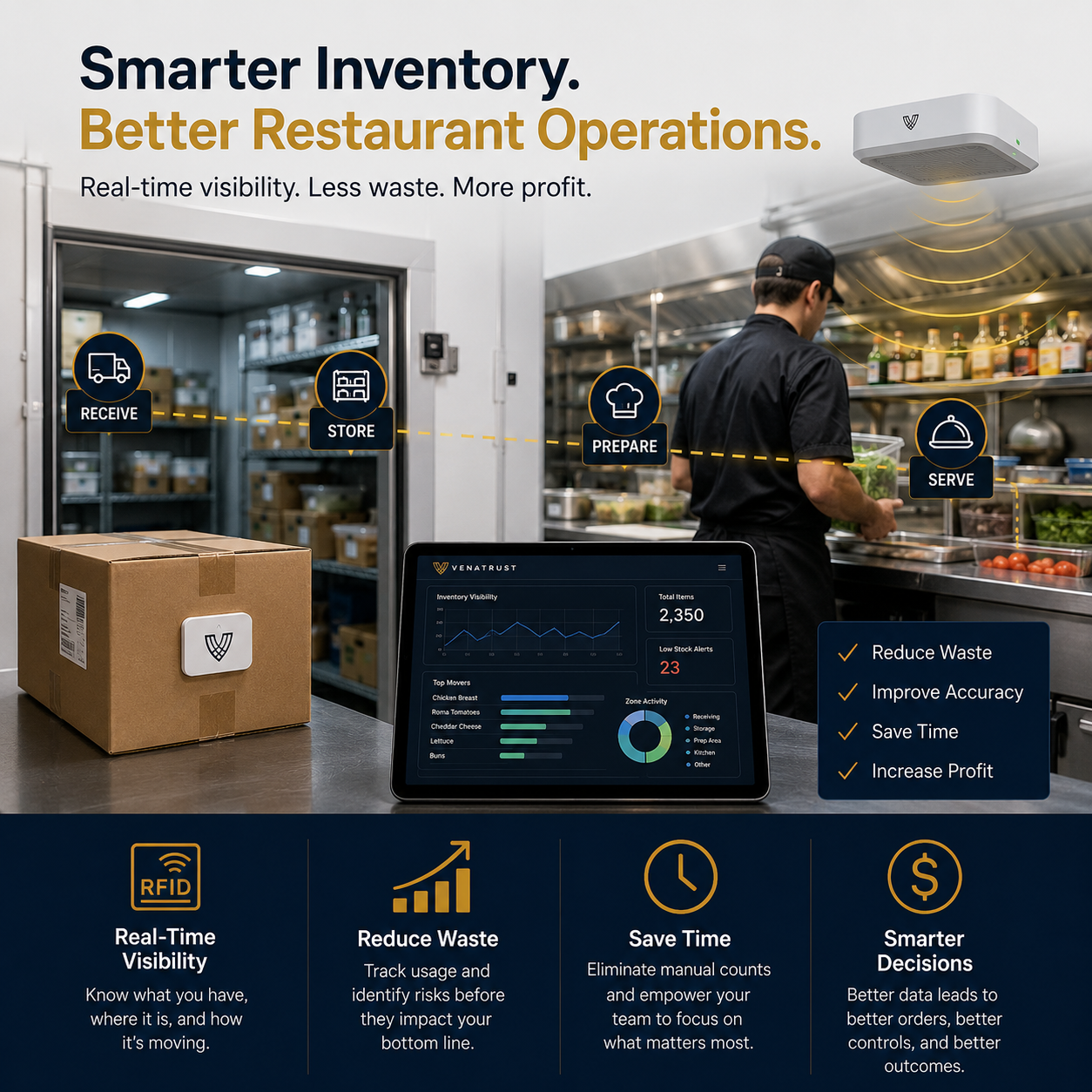
Venatrust takes RFID beyond simple inventory tracking by creating continuous visibility across multiple operational areas.
Using Venatrust's multizone RFID readers, restaurants can monitor inventory movement throughout the facility—from the moment products arrive until they are prepared and served.
Readers can monitor areas such as:
- Receiving docks
- Walk-in coolers
- Freezers
- Dry storage rooms
- Kitchen preparation areas
- Back-of-house operations
Every movement creates valuable operational data.
Restaurant managers gain a clearer understanding of where products are located, how quickly they are moving, and whether inventory is flowing through the operation as expected.
Better Data Leads to Better Decisions
One of the greatest benefits of real-time inventory visibility is improved decision-making.
Instead of relying on assumptions or outdated reports, restaurant leaders have access to accurate operational information that supports smarter decisions every day.
With continuous inventory visibility, teams can quickly answer critical questions such as:
- What inventory was received today?
- Has every shipment been accounted for?
- Where is each product currently located?
- Which ingredients are moving fastest?
- Which products remain untouched?
- Are inventory levels approaching reorder points?
- Are products flowing through operations efficiently?
When managers have answers to these questions, purchasing becomes more accurate, forecasting improves, and inventory costs become easier to control.
Reducing Food Waste Through Better Visibility
Food waste remains one of the largest financial challenges facing restaurants.
Spoilage, over-ordering, forgotten inventory, and improper stock rotation all contribute to unnecessary losses.
Without accurate inventory data, restaurants often discover these problems only after food has already been discarded.
RFID helps address this challenge by providing greater visibility into inventory movement and usage.
Restaurants can identify slow-moving inventory, monitor high-loss products, recognize purchasing trends, and make adjustments before waste occurs.
Combined with other operational best practices, this visibility helps reduce unnecessary food loss while improving overall profitability.
Improving Employee Productivity
Restaurant employees create the greatest value when they're focused on guests—not counting inventory.
Automating inventory tracking significantly reduces the amount of time spent performing manual counts, allowing teams to dedicate more attention to food preparation, customer service, quality control, and operational excellence.
Managers also spend less time reconciling inventory discrepancies and more time making strategic decisions that improve restaurant performance.
The result is a more productive team and a more efficient operation.
The Future of Restaurant Inventory Management
Restaurant operations continue to evolve alongside new technologies.
The future is moving away from periodic counting and toward continuous awareness.
Instead of wondering whether inventory records are accurate, operators will have confidence that they reflect what's actually happening throughout the restaurant.
By combining RFID hardware with intelligent software, Venatrust helps restaurants transform inventory from a manual process into a continuous source of operational intelligence.
Restaurants gain better visibility, improved efficiency, stronger inventory control, and the data needed to make smarter business decisions.
In an industry where every ingredient, every labor hour, and every dollar matters, continuous inventory visibility isn't just a technological upgrade—it's a competitive advantage.
With Venatrust's RFID-powered multizone technology, restaurants can reduce waste, improve operational efficiency, strengthen inventory accuracy, and build a smarter, more connected operation prepared for the future.
