
Inventory Management 101: The Foundation of Every Efficient Operation
Every organization manages inventory in some form. Whether it's a retailer stocking shelves, a warehouse fulfilling customer orders, a restaurant managing food supplies, or a government agency tracking mission-critical assets, inventory is one of the most valuable—and expensive—resources an organization owns.
Yet despite its importance, inventory is often managed with surprisingly limited visibility.
Many organizations still rely on manual counts, spreadsheets, barcode scans, and periodic audits to understand what they have. While these methods have worked for decades, today's operations move too quickly for yesterday's inventory practices.
Modern inventory management is no longer just about counting products. It's about creating continuous visibility into every asset, every movement, and every decision.
What Is Inventory Management?
At its simplest, inventory management is the process of tracking and controlling the flow of physical goods throughout an organization.
That includes everything from receiving products and storing them to using them, moving them, replenishing them, and ultimately delivering them to customers or end users.
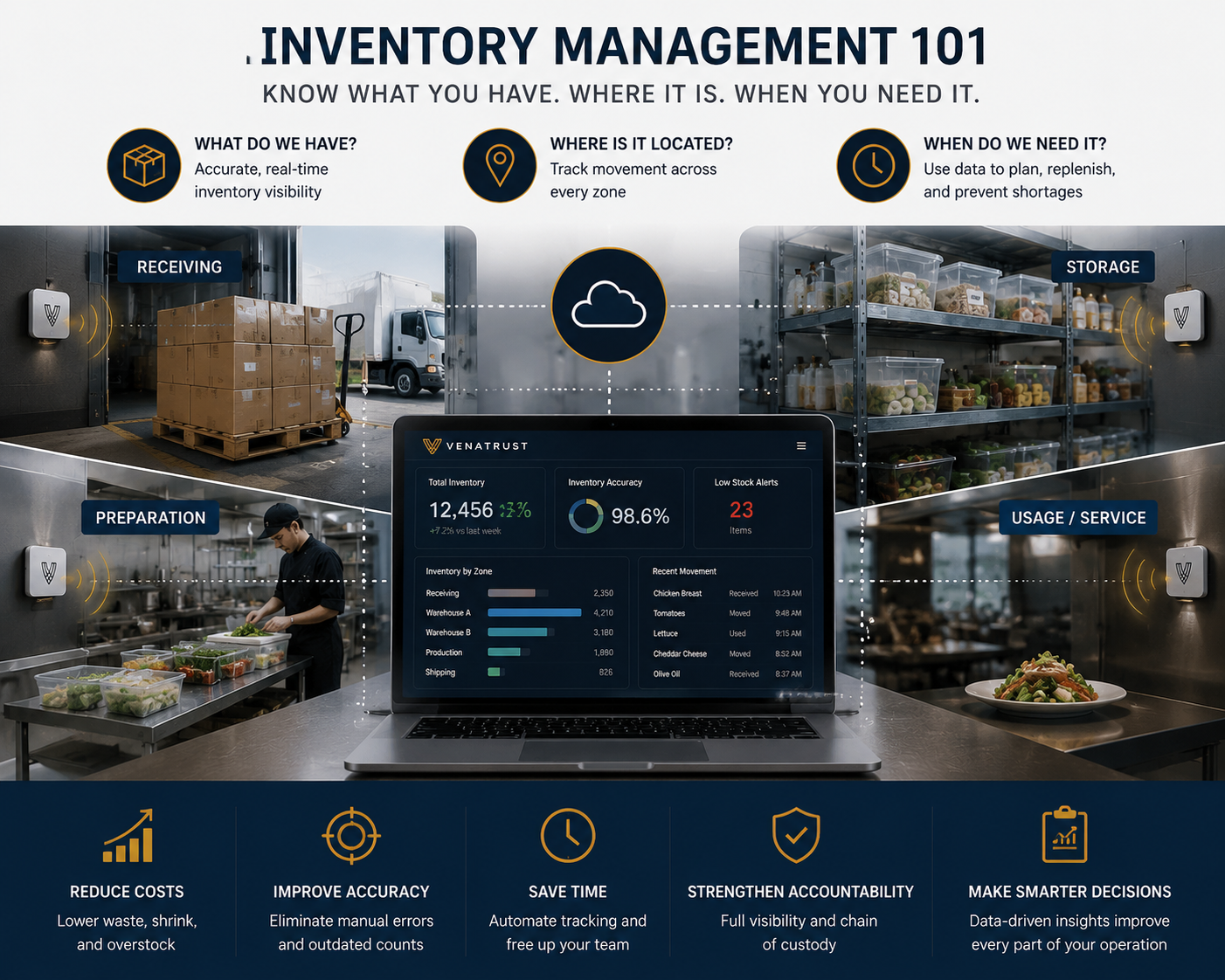
Regardless of the industry, every organization is trying to answer three fundamental questions:
- What do we have?
- Where is it located?
- When do we need it?
These questions may sound simple, but for organizations managing thousands—or even millions—of items across multiple facilities, answering them accurately can be incredibly difficult.
Without reliable inventory information, every operational decision becomes more uncertain.
Why Inventory Management Matters
Inventory is much more than products sitting on shelves. It represents working capital. Every item in inventory has already been purchased. Until it is sold, consumed, or deployed, that investment is tied up inside the business.
Poor inventory management affects nearly every aspect of an organization.
It can lead to:
- Overstocked inventory that ties up cash
- Stock shortages that delay operations
- Increased labor costs from manual counting
- Lost or misplaced assets
- Higher inventory shrink
- Food waste and spoilage
- Delayed customer orders
- Inaccurate financial reporting
- Reduced operational efficiency
Conversely, organizations with accurate inventory visibility can optimize purchasing, improve forecasting, reduce waste, and respond more quickly to changing business conditions. Inventory management isn't just a warehouse function—it is a business strategy.
The Challenges of Traditional Inventory Management
For many organizations, inventory management still depends heavily on manual processes. Employees walk aisles counting products. Warehouse teams scan individual barcodes. Managers update spreadsheets. Operations teams reconcile discrepancies after inventory counts are complete. These methods require significant labor while introducing opportunities for human error.
As operations become larger and more complex, manual inventory management becomes increasingly difficult to sustain. The biggest challenge is that manual inventory only provides a snapshot in time. The moment a physical inventory count is completed, inventory immediately begins changing. Products are received. Orders are fulfilled. Items are relocated. Inventory is consumed. Assets move throughout the facility.
By the time the next inventory count occurs, the information may already be outdated. Organizations aren't managing inventory in real time—they're constantly trying to catch up.
Visibility Is the Foundation of Modern Inventory Management
The most successful inventory programs begin with visibility.
Before organizations can optimize purchasing, improve forecasting, reduce waste, or increase efficiency, they must first understand what is actually happening throughout their operations.
Visibility means knowing:
- What inventory is currently available
- Where every item is located
- How inventory moves throughout the facility
- Which products are being consumed
- Which assets remain idle
- Where bottlenecks occur
- When inventory levels require attention
When organizations have access to accurate, real-time information, every downstream decision becomes better.
Instead of reacting to problems after they occur, managers can proactively address issues before they impact operations.
Technology Is Changing Inventory Management
Advances in automation are transforming the way organizations manage inventory.
Rather than relying exclusively on manual processes, organizations are increasingly using technologies such as:
- RFID (Radio Frequency Identification)
- IoT sensors
- Computer vision
- Autonomous drones
- Intelligent software platforms
- Real-time analytics
These technologies automate inventory data collection, allowing organizations to understand inventory movement continuously instead of periodically. For example, RFID enables multiple tagged items to be identified automatically without requiring line-of-sight scanning. Sensors can monitor environmental conditions such as temperature and humidity. Software platforms consolidate information from multiple sources into a single operational view.
Together, these technologies create something traditional inventory systems have struggled to provide: continuous visibility.
Moving from Inventory Tracking to Inventory Intelligence
Collecting data is only the beginning. The true value of modern inventory management comes from transforming that data into actionable intelligence. Organizations don't simply want to know how many items they have.
They want to understand:
- Why inventory levels are changing
- Which products move fastest
- Where bottlenecks are developing
- How purchasing should be adjusted
- Which assets are underutilized
- Where operational improvements can be made
This shift—from inventory tracking to inventory intelligence—allows organizations to make decisions based on real operational activity rather than assumptions.
How Venatrust Modernizes Inventory Management
At Venatrust, we believe inventory visibility should be continuous, automated, and actionable. Our platform combines RFID technology, multizone readers, intelligent software, and real-time data into a complete inventory intelligence ecosystem. Instead of relying on periodic inventory counts, Venatrust continuously captures inventory movement throughout warehouses, retail stores, restaurants, government facilities, and other operational environments. Every movement becomes part of a living digital record.
Organizations gain real-time visibility into:
- Inventory location
- Asset movement
- Inventory utilization
- Chain of custody
- Operational trends
- Inventory accuracy
Because the platform integrates with existing enterprise systems, organizations can enhance—not replace—their current technology investments while adding an entirely new layer of operational intelligence. The result is better inventory accuracy, improved labor efficiency, reduced shrink, stronger accountability, and faster decision-making.
The Future of Inventory Management
The future of inventory management is no longer about counting inventory more frequently. It is about knowing what is happening every moment of every day. As organizations continue adopting automation, artificial intelligence, connected devices, and predictive analytics, inventory visibility will become a foundational capability rather than a competitive advantage.
The organizations that thrive will be those that replace manual processes with intelligent systems capable of continuously monitoring inventory and transforming data into action. At Venatrust, we're helping organizations make that transition. By connecting the physical world with intelligent digital systems, we enable businesses and government agencies to know what they have, where it is, how it is moving, and what that information means for their operations. Because the future of inventory management isn't simply about tracking products. It's about turning physical inventory into real-time operational intelligence - empowering organizations to reduce costs, improve efficiency, strengthen accountability, and make smarter decisions every single day.
