
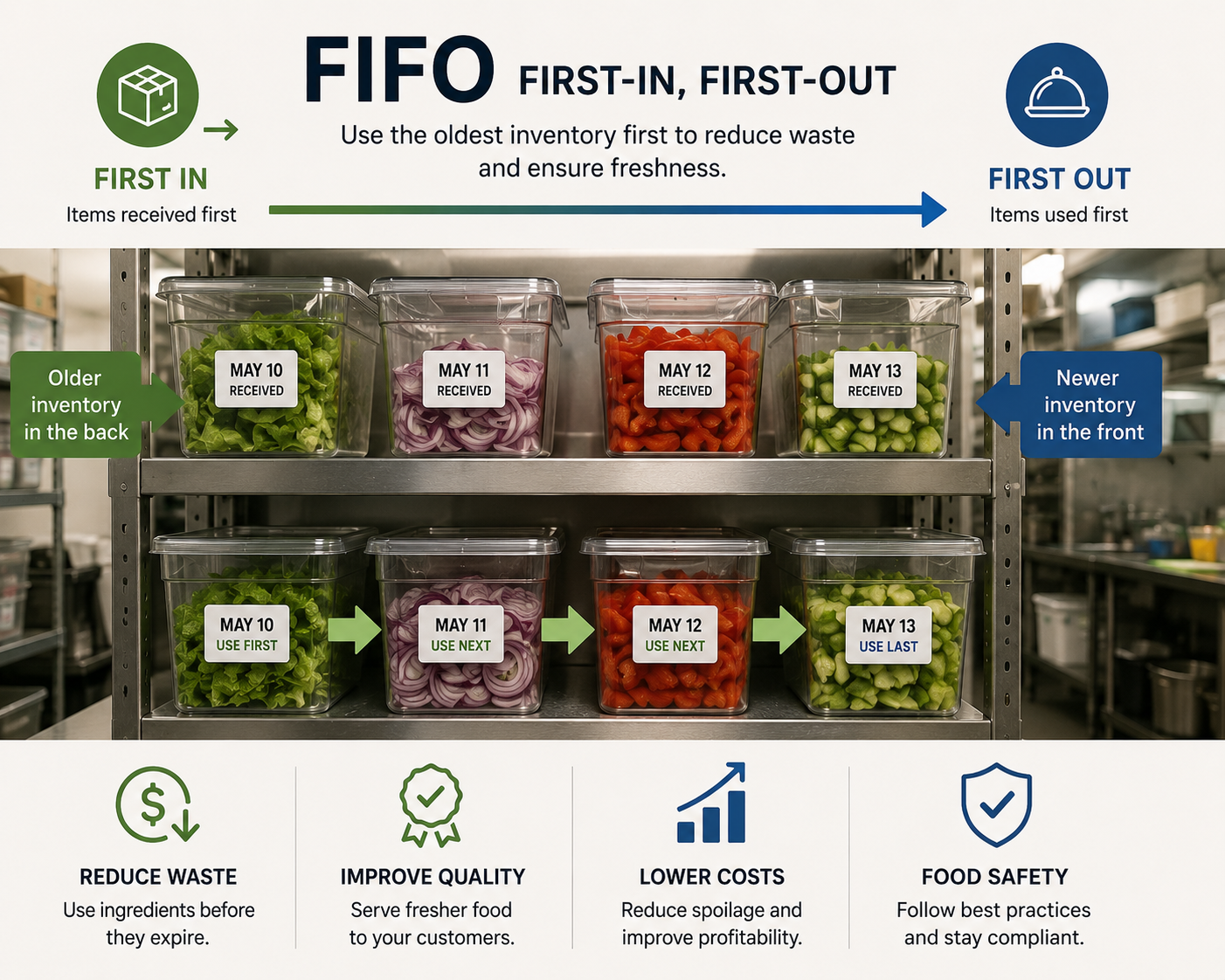
FIFO Inventory Management: Why Every Restaurant Should Automate First-In, First-Out
In the restaurant industry, food quality begins long before a meal reaches the customer. It starts the moment ingredients are delivered to the back door.
Every case of produce, every carton of dairy, every package of meat, and every ingredient has a limited shelf life. If inventory isn't used in the proper order, restaurants risk spoilage, unnecessary food waste, higher food costs, and even food safety concerns.
That's why one inventory practice has become a cornerstone of successful restaurant operations for decades: FIFO, or First-In, First-Out.
FIFO is one of the simplest inventory concepts to understand, yet one of the most difficult to execute consistently in a busy restaurant environment.
Today, technology is changing that. By combining RFID, real-time inventory visibility, and intelligent automation, restaurants can transform FIFO from a manual responsibility into an automated operational advantage.
What Is FIFO?
FIFO stands for First-In, First-Out. The principle is straightforward:
The first products that enter inventory should be the first products used. If a case of lettuce arrives on Monday and another shipment arrives on Wednesday, the Monday shipment should be used first. The same principle applies to dairy products, meats, sauces, beverages, frozen foods, dry goods, and virtually every ingredient throughout the restaurant.
The goal is to ensure older inventory is consumed before newer inventory enters production.
When FIFO is consistently followed, restaurants minimize spoilage, reduce waste, improve food quality, and maintain more predictable inventory turnover.
Why FIFO Matters
FIFO isn't simply about organization—it's one of the most important operational practices for controlling food costs and protecting customers.
Proper inventory rotation helps restaurants:
- Reduce expired inventory
- Minimize food waste
- Improve ingredient freshness
- Maintain consistent food quality
- Improve purchasing accuracy
- Increase inventory turnover
- Reduce unnecessary food costs
- Strengthen food safety practices
For restaurants operating on narrow profit margins, even small improvements in inventory rotation can create significant financial benefits over the course of a year.
FIFO and Food Safety
FIFO is also closely connected to food safety.
Food safety guidance and inspection standards emphasize proper stock rotation as a fundamental practice for preventing expired or deteriorated food from being served. Restaurant operators are expected to label products appropriately, monitor storage times, rotate stock consistently, and ensure older inventory is used before newly received inventory.
When FIFO is followed correctly, restaurants reduce the likelihood that ingredients remain in storage beyond their usable life.
This helps lower the risk of serving degraded products while supporting consistent quality and safer food handling practices.
Although FIFO alone does not replace temperature monitoring, sanitation, or proper storage procedures, it is one of the foundational practices of an effective food safety program.
Why FIFO Is Difficult to Maintain
The concept is easy. The execution is not. Modern restaurants receive deliveries almost every day.
Inventory is constantly moving between:
- Receiving docks
- Walk-in coolers
- Freezers
- Dry storage
- Prep stations
- Line kitchens
- Catering operations
- Multiple restaurant locations
During busy service periods, employees naturally focus on speed.
Boxes may be placed in front of older inventory.
Products may be moved between storage areas.
Labels may become damaged or difficult to read.
New employees may not know which items arrived first.
By the end of the week, products that should have been used first are buried behind newer deliveries.
Eventually those products expire.
Not because anyone intended to waste food—but because the operation lacked visibility.
The Limitations of Manual FIFO
Most restaurants still rely on manual FIFO processes. Employees rotate inventory by hand. Managers inspect expiration dates. Shelves are reorganized. Labels are checked repeatedly throughout the day. While these practices remain important, they also introduce challenges. Manual systems depend entirely on people remembering to perform the same repetitive tasks every day.
As restaurants become busier, consistency becomes harder to maintain. Managers simply don't have enough time to verify every cooler, every shelf, and every ingredient multiple times throughout each shift. The result is that FIFO gradually becomes less effective.
Automating FIFO with RFID Technology
Technology now allows restaurants to move beyond manual inventory rotation. Instead of relying solely on employees to remember what arrived first, RFID technology automatically creates a digital record of inventory movement throughout the restaurant.
Every tagged product entering the operation can be associated with the time it was received and tracked as it moves through storage and preparation areas. Rather than asking employees to remember which case belongs in front, the system already knows.
How Venatrust Automates FIFO
Venatrust's RFID-powered inventory platform helps restaurants bring intelligence to inventory rotation.
Using strategically placed multizone RFID readers, Venatrust continuously monitors inventory movement across the operation.
Readers can automatically capture activity in areas such as:
- Receiving docks
- Walk-in coolers
- Freezers
- Dry storage
- Preparation areas
- Kitchen production zones
Every inventory movement contributes to a continuously updated digital inventory record.
Managers gain visibility into:
- When products were received
- Where products are currently located
- How long inventory has been stored
- Which items should be used first
- Which products may be approaching expiration
- Where inventory movement may not align with FIFO practices
Instead of relying only on shelf labels or spreadsheets, restaurants have access to real-time information that supports smarter operational decisions.
Smarter Decisions, Less Waste
Automated FIFO creates benefits that extend far beyond inventory organization. Restaurants can identify slow-moving inventory before it expires. Managers can recognize purchasing patterns that contribute to overstocking. Employees spend less time searching for ingredients and more time serving guests.
Ordering becomes more accurate because inventory usage reflects actual operational activity rather than assumptions.
Most importantly, restaurants reduce the amount of perfectly good food that ends up in the trash.
The Future of Inventory Rotation
FIFO has been an industry best practice for decades. That isn't changing. What is changing is how restaurants manage it. Rather than depending entirely on manual organization and routine inspections, restaurants now have the opportunity to automate visibility into inventory movement.
By combining RFID technology with intelligent software, Venatrust transforms FIFO from a checklist into a continuously monitored process.
The result is better inventory control, improved food quality, stronger food safety practices, reduced waste, and greater confidence that products are being used exactly as they should be.
The future of restaurant inventory management isn't about asking employees to work harder—it's about giving them better tools.
With Venatrust's RFID-powered inventory intelligence platform, FIFO becomes more than a best practice. It becomes an automated strategy for protecting food quality, reducing costs, improving operational efficiency, and maximizing the value of every ingredient that enters your restaurant.
